

Yesterday afternoon, in the Melvin Center at Upper Anderson Auditorium, the Mountain Retreat Association held an open meeting to discuss its latest plans for the new lodge on its campus. (You can view a recording of that meeting, which was also livestreamed, here.)
To summarize, I reviewed the work that our board and staff have undertaken on the project since the decision by the North Carolina Court of Appeals last November that restored Montreat Conference Center’s special use permit (SUP) to build the lodge and our plans for next steps. At its meeting in March, our board set a course that, we believe, will enable us to begin construction later this year. At the same time, the board’s actions open a door to an improved design which would accomplish our project goals while being more sensitive to the past concerns of immediate neighbors in our midst.
In the first step, the board directed us to begin construction on the new lodge as soon as the necessary approvals and funding are met. The lodge will include guest rooms, meeting space, dining space, kitchen facilities, a spacious lobby, and underground parking, all designed to welcome and gather guests in the spirit of Montreat’s hospitality. We hope to break ground later this year.
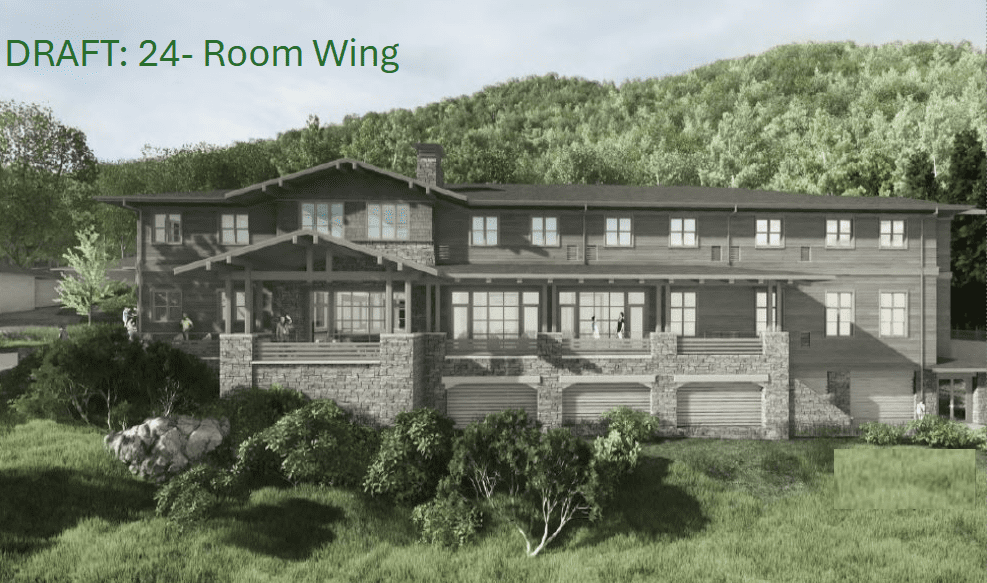
The action taken by the board is straightforward and exciting, straightforward because the design will follow closely the plans approved by the Board of Adjustment at its meeting in January 2022, and exciting because the project will begin with the 24-room lower wing of the design (you can see that wing represented in blue in the image below).
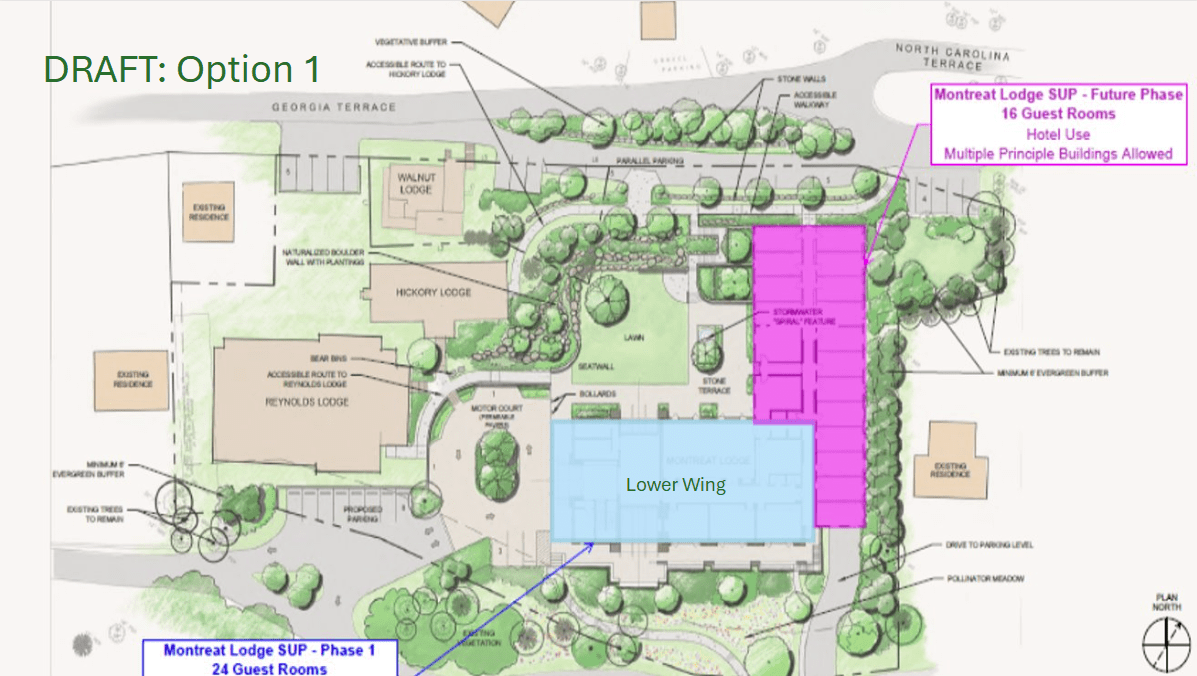
Focusing on this lower wing allows us to 1) get started, and 2) consider an alternative plan for the project that offers the opportunities for addressing neighbors’ concerns referenced above, keeping in mind our need to achieve our goals across the remainder of the site. In its discussions, the board considered two options for completing the project that differ in significant ways:
Option One is the simplest alternative. We can complete the original design by adding the second wing as originally approved in the SUP.
Option Two: Instead of completing the original design, we can develop a cluster of smaller residences on the site. In what some board members refer to as the “Cottage Plan,” these residential facilities would be placed on Georgia Terrace, across the street from neighboring homes. (You can see the suggested locations for these residences in the image below, along with renderings of their design and appeal.)
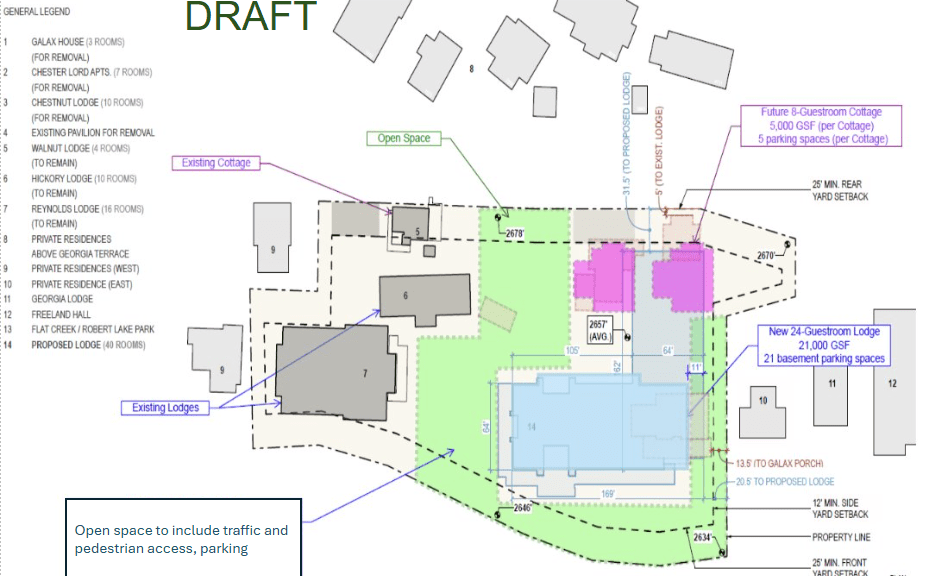
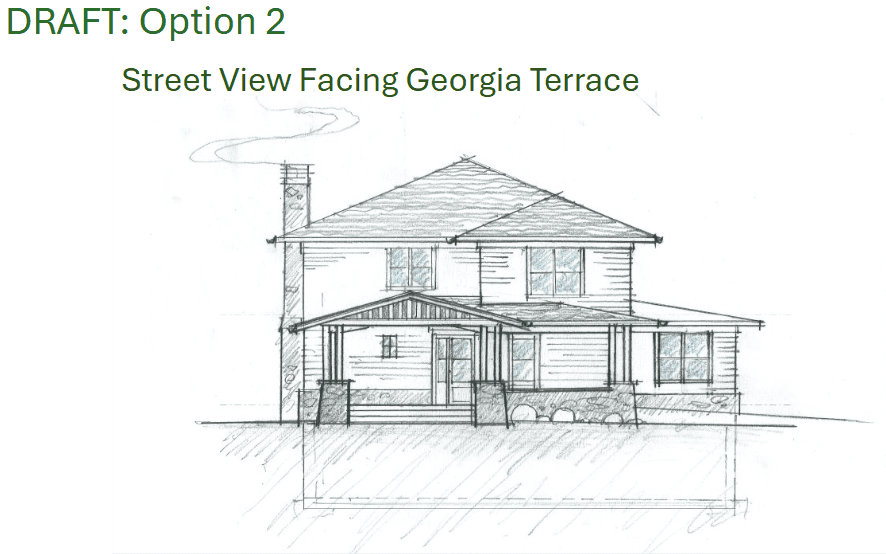
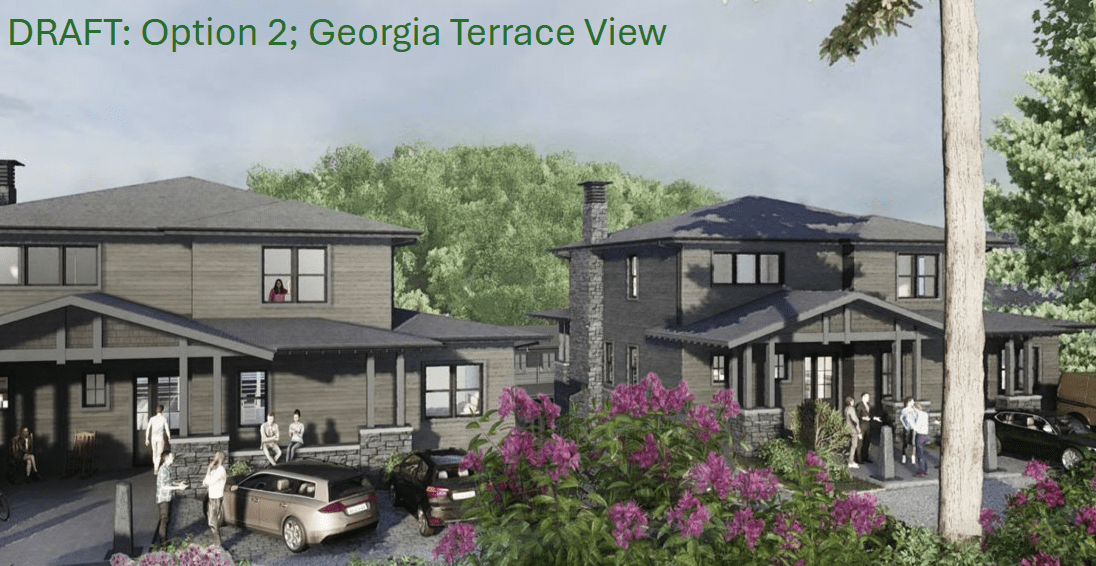
Option Two offers meaningful advantages. First, pricing estimates are competitive when compared to Option One, particularly given the quality of construction we are seeking to pursue. Second, a cluster of separate but connected buildings allows us to host multiple smaller groups more easily and effectively — for example, three groups in three distinct buildings, while still maintaining the ability to host a larger group on the overall site when necessary. In Option Two, the 24-room wing — now the entire lodge — would still contain sufficient meeting and dining spaces capable of hosting joint activities, shared meals, worship, and gatherings for the residents of all three buildings.
Also, because a 24-room lodge on its own would represent a significant reduction in square footage and footprint from the original design, space opens up for opportunities to respond to neighbors’ concerns. For example, the 24-room wing moves the lodge’s east wall an additional eleven feet west, creating a buffer of more than 30 feet from the property line that the conference center shares with a neighboring home. Without the addition of the second wing, the façade facing that home is significantly reduced. Taken together, these changes allow for an increase in the vegetative buffer between the two buildings.
In the board’s discussions, several board members noted that a plan that includes residential facilities shares, in a meaningful way, some principles of the “village concept” put forward by neighbors several years ago. Option Two swaps out one large structure in favor of multiple buildings and distributes the built environment across the property. It places residential design along Georgia Terrace and provides a residential character to those viewing the site from above. Also, the buildings are arranged to create a natural, communal green space in the interior of the site.
So, if Option Two offers more advantages for neighbors (our opinion) and allows the MRA to accomplish its project goals, why not just pass a resolution to pursue it?
Simply put, Option One retains one advantage over Option Two: With our Special Use Permit reestablished by the court, we have permission to build Option One. To build Option Two, the MRA will need additional approvals that supersede the current permit and include the residential facilities.
And yet, despite this important detail, Board members signaled their enthusiasm for Option Two, stating that “a residential-style plan would be fully consistent with the project goals and the mission of the MRA,” and directed staff to seek both input from the community and approval from the Town of Montreat to provide us the ability to develop the remainder of the site in a residential-style format.
If we are successful, we can all move forward to make this exciting plan a reality as soon as possible. Regardless of the option, we need new lodging now and must enhance this property to serve its original purposes in a way that reflects Montreat’s history and maintains Montreat’s calling: serving generations to come with hospitality and care. As we continue planning and engagement, we remain grateful for your thoughtful attention and input, and we look forward to that dialogue as we move toward the completion of this most important project.
More to come,

Richard DuBose
President, Montreat Conference Center
Have questions or comments? Reach out to us at lodgeproject@montreat.org.