
One morning earlier this summer, I happened to glance out my office window just as a construction vehicle was making its way slowly up Assembly Drive. So slowly, in fact, that its cargo immediately caught my attention: an enormous steel I-beam, nearly 60 feet long, carefully balanced and escorted up the hill toward Lake Susan. It looked like quite an undertaking. I was curious – but, apparently, not curious enough to leave my desk and investigate.
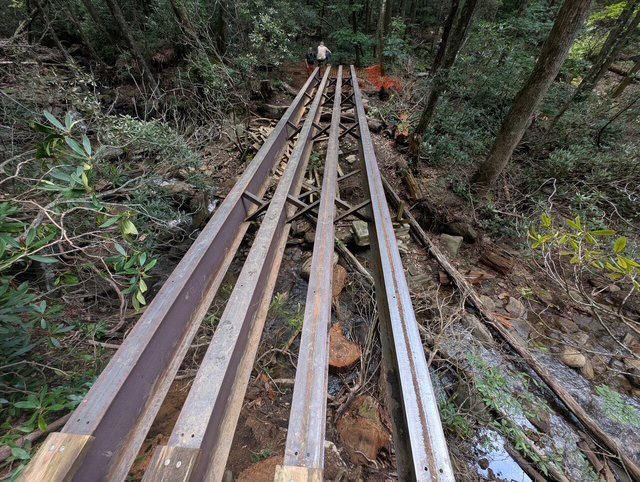
As it turns out, that beam was just one of four beams destined for the Harry Bryan Bridge1 repair, where work crews were installing new steel supports to span the upper reaches of Flat Creek. The bridge, which conveys hikers along the Harry Bryan Trail at the lower elevations of the Montreat Wilderness, was one of two major wilderness bridges destroyed by Hurricane Helene. The other, located at the foot of Graybeard Trail, was also washed away during the storm.
Replacing these bridges has proven to be a challenge. Leadership on our Wilderness Committee consulted several experts, drawing a conclusion that the new Bryan Bridge should be repositioned upstream in a location more resilient to future storms and potential damage. The move would necessitate a substantially longer span but also represented a chance not only to build a better bridge but to solve another problem as well.
Our friends with Emergency Medical Services and Search & Rescue have pointed out that the narrow pathways and bridges in the Montreat Wilderness are not designed for utility vehicles and have offered limited access, in some cases hindering their work, when every minute matters. Those I-beams will leave the Harry Bryan Bridge a stronger, wider crossing, capable of supporting an EMS utility vehicle and giving first responders more options to reach hikers efficiently when emergencies arise.
Projects like these rarely happen without partners. We are especially grateful to the Community Foundation of Western North Carolina, whose support has helped communities across the region recover from Hurricane Helene and whose generosity made the Bryan Bridge restorations possible, and to Blue Ridge Trail Works, who has assisted with the construction. (Beyond generosity, we appreciate their patience. With the new Bryan Bridge being a replacement rather than a repair, there were more permissions needed, stretching the timeline well beyond what anyone initially anticipated.) The Bryan Bridge project should be finished before the end of August. We also want to thank Donna and Whit Kennedy, who supported the restoration of the Graybeard Bridge, completed in time for the summer season.
Another long-awaited project that was both delayed and made more urgent by Helene is the resurfacing of the courts at the Patricia Cornwell Tennis Center. Beginning next week, workers will begin resurfacing, repainting, and refencing the courts to provide smooth, safe tennis (5) and pickleball (12) courts. This facility has seen increased activity in recent years with the ascendance of pickleball, and the new surface will allow for safe and fun dinking and lobbing years into the future. This work is expected to be completed by Labor Day.
Two years after Hurricane Helene, across Western North Carolina and here in Montreat, important restoration work continues every day. Some projects are visible, like a new bridge stretching across a creek. Others happen quietly behind the scenes, and yes, can even drive by your window without your giving it a second thought. Altogether, the work reminds us that the long, faithful process of rebuilding continues, with valued partners, to fulfill a vision of serving future generations even better than before.

Richard DuBose
President, Montreat Conference Center
- Harry Bryan Trail” in the second paragraph should have a footnote of “The Harry Brian Trail, a favorite of locals in particular, has been closed since the storm. ↩︎